Here’s a thing nobody tells you about smart homes: the expensive part was never the gadgets. It was the mistakes. I’ve watched friends burn through serious money buying the wrong ecosystem, then slowly replace everything piece by piece — which is basically the most expensive way possible to build anything. The good news? In 2026, a smart home that actually feels smart costs way less than most people assume, as long as you build it in the right order.
Honestly, the whole game changed a couple of years ago when Matter finally started working the way it was supposed to. Before that, buying cheap smart home gear felt like gambling — you had no idea if a random smart plug would talk to your speaker or just sit there blinking at you mockingly. Now, cross-brand compatibility is genuinely decent, and that means budget brands are no longer the sketchy gamble they used to be. This guide is the no-regrets roadmap: what to buy first, what to skip, and the traps that quietly double your spending.
Looking for the best deal?
Pick Your Ecosystem First (This Is the Whole Game)
Before you buy a single bulb, decide whose world you’re living in: Alexa, Google Home, or Apple HomeKit. This is the one decision you really don’t want to undo later, because it’s the foundation everything else stacks on. And here’s my honest take — there’s no wrong answer anymore, but there is a wrong-for-you answer.
Alexa remains the budget king, and it’s not particularly close. Echo speakers and displays go on sale constantly, the device ecosystem is enormous, and Routines are genuinely powerful once you start stacking triggers. If you’re watching your wallet, Alexa gives you the most smart home per dollar. Google Home is the middle path — its voice understanding is still the best of the bunch, and if your life runs on Gmail, Calendar, and Google Photos, the integration feels seamless. Apple HomeKit is the premium play: tighter privacy, beautiful Home app, but the hardware tax is real and Matter support narrowed the gap so much that the premium is harder to justify on a budget.
My actual advice? If you already own an iPhone, don’t overthink it — pick whichever assistant you’ll actually talk to daily. Most budget smart home gear in 2026 works with all three through Matter anyway. The ecosystem pick matters less than it did in 2022, but it still matters for your voice speaker, and that’s your first purchase.
Step 1: The Voice Speaker (Your Command Center)
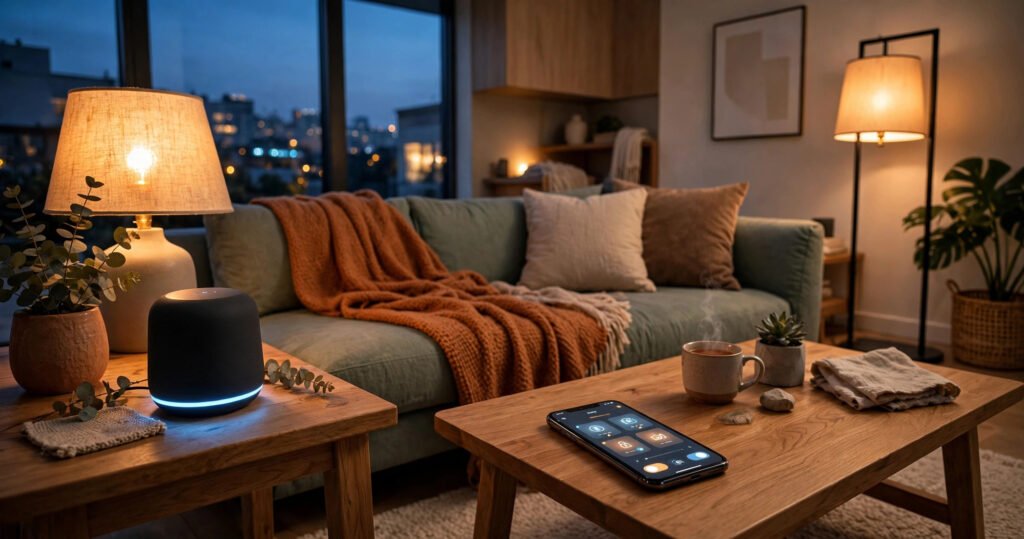
Everything starts with one smart speaker, and this is the one place I’d say buy from your chosen ecosystem directly — an Echo, a Nest speaker, or a HomePod mini. It’s the brain of the operation, and first-party speakers get features and updates fastest. You don’t need the big flagship model. The compact versions handle voice control and automation perfectly well, and they end up in a corner of the room most of the time anyway.
Pro tip that saves real money: these go on massive discount during every major sale event. If you can wait a few weeks for a holiday sale, do it. I’ve never once paid full price for a smart speaker, and neither should you. Buy one now to start, and add a second for another room later once you’re hooked — because you will be.
Step 2: Smart Plugs (The Unsung Heroes)
Ask me what the best value in all of smart home tech is and I won’t hesitate: smart plugs. A pack of smart plugs turns every “dumb” device you already own into a smart device. That ancient floor lamp? Smart now. The coffee maker with no WiFi? It turns on with your morning routine. The fan you wish you could control from bed? Done.
This is where Matter-compatible budget plugs really shine in 2026. You don’t need a hub, you don’t need the same brand as your speaker, and setup takes about two minutes. Start with a multi-pack — they’re the cheapest way to smart-ify a whole room — and put them on the stuff you touch every day. The lamp you turn on at 6 PM and off at midnight? That single plug will automate a hundred tiny decisions a year, and you’ll feel the difference within a week.
Step 3: Smart Bulbs (Fewer Than You Think)
Here’s where most beginners overspend: they buy twelve smart bulbs on day one and then spend a weekend screwing them all in. Don’t. Start with the rooms where lighting actually changes your life — the bedroom (wake up to a slow sunrise fade instead of an alarm blaring at you) and the living room (one voice command dims everything for movie night).
Color bulbs are fun, but here’s the trade-off nobody mentions: most of the time you’ll use warm white. The rainbow party mode is a two-weeks-of-novelty thing. So for a budget build, I’d rather have a couple of good white-tunable bulbs in the right rooms than color bulbs everywhere. White-tunable covers morning daylight, evening wind-down, and everything between, which is what you’ll actually use. If you crave color later, grab one color bulb for a single accent lamp and scratch the itch cheaply.
Step 4: The Thermostat Question
A smart thermostat is one of those purchases that pays for itself — but only if you actually have the kind of schedule that benefits. If you’re home all day or your schedule is chaotic, the savings are modest. If you leave for work at the same time every day and come home at the same time, the auto-scheduling is genuinely one of the highest-ROI smart home purchases you can make.
The catch: compatibility. Before you buy, check that your HVAC wiring has the right connections — most smart thermostat makers have an online compatibility checker, and it takes two minutes. This is the one purchase in the budget smart home where doing five minutes of homework prevents a very annoying return. When it works, it’s set-and-forget: your home learns when you’re away and stops heating an empty house. That’s not just convenience, it’s money back in your pocket every month.
What to Skip (For Now)
A budget smart home is as much about what you don’t buy as what you do. Smart doorbells and cameras are great, but they’re a whole category with their own subscription costs — buy one later as its own project, not bundled into your starter build. Robot vacuums are wonderful machines but they’re not really “smart home” — they’re appliances with an app, and they deserve their own budget line.
And the big one: skip the whole-home everything-bundles. Those starter kits that promise a complete smart home in one box usually include stuff you don’t need and lock you into one brand’s ecosystem. Building piece by piece feels slower, but you end up with exactly the devices you use, and nothing gathering dust in a drawer. The drawer of abandoned smart home gadgets is the most expensive room in the house.
The No-Regrets Order of Operations
If I were starting from zero tomorrow with a tight budget, here’s the exact order I’d go in. Week one: one smart speaker and a multi-pack of smart plugs. Live with that for a month. You’ll be shocked how much those two purchases change daily life — and just as importantly, you’ll learn how you actually use voice control, which tells you what to buy next.
Month two: smart bulbs for the bedroom and living room, plus a second speaker if you want multi-room audio or voice control upstairs. Month three: that’s when you evaluate the thermostat, or a smart lock, or whatever specific pain point has been bugging you. By then you’re not guessing — you know your routines, your ecosystem, and your habits. Every purchase from that point is targeted instead of hopeful, and that’s the whole secret to building a smart home on a budget: never buy the next thing until the current setup has taught you what you actually need.
The Verdict
Building a smart home on a budget in 2026 isn’t about finding the cheapest gadgets — it’s about buying in the right order and skipping the stuff that looks exciting in a product photo but dies in a drawer. One speaker, a handful of plugs, a few well-placed bulbs, and a thermostat if your schedule justifies it. That’s a genuinely smart home for less than most people spend on a single flagship phone accessory, and every piece of it earns its place daily.
Start small, learn your habits, then expand with intention. If you’re ready to start, check the current price on Amazon for a starter bundle and see how far the basics take you before you spend another dollar.
As an Amazon Associate I earn from qualifying purchases.
Check the price on AliExpress — the global marketplace with millions of tech products.
As an AliExpress affiliate, we may earn a commission on qualifying purchases.