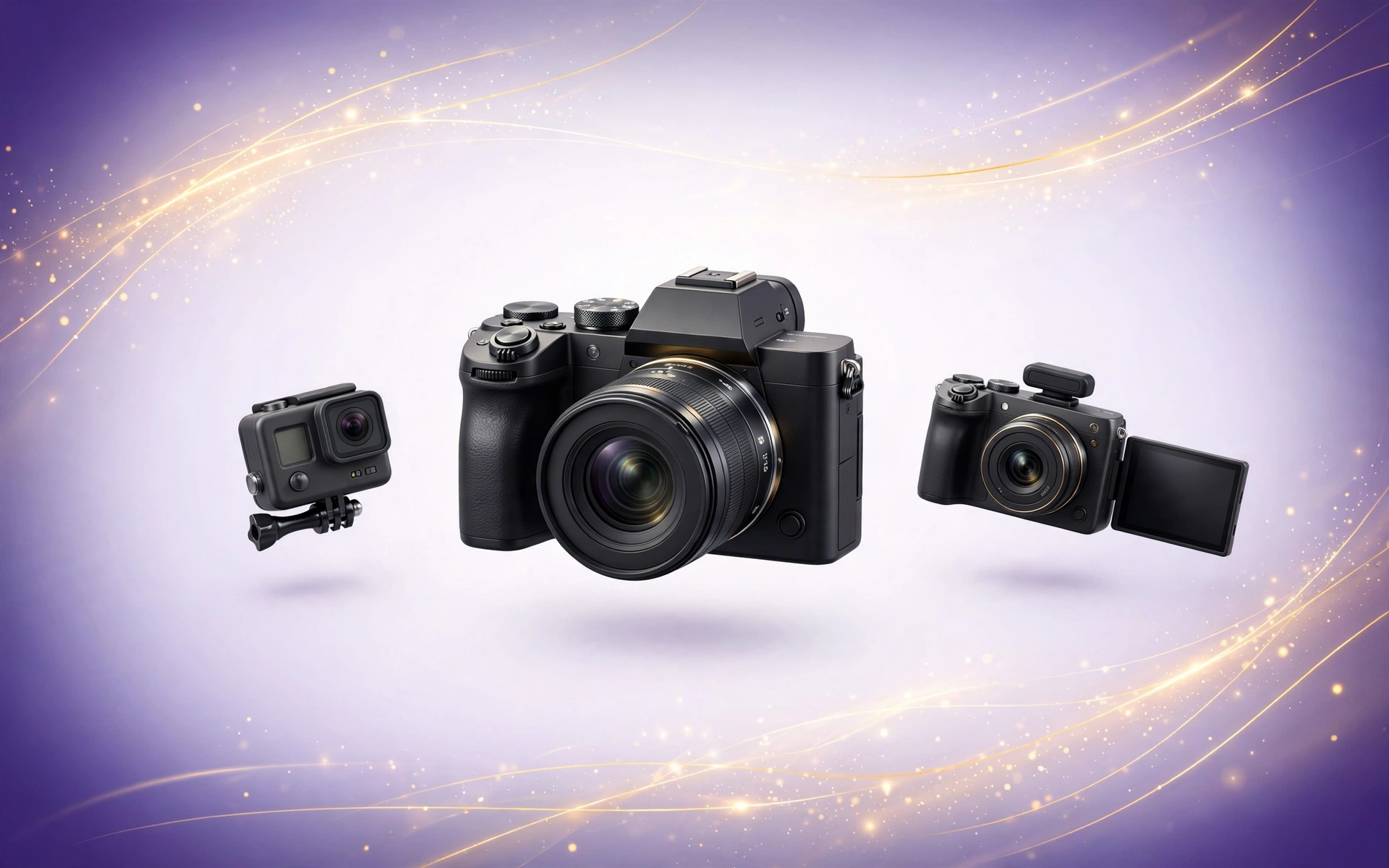
Sony vs Canon vs Nikon in 2026: Which Mirrorless System Should You Buy Into?
Buying a mirrorless camera isn’t buying a camera. It’s buying into a system — a lens mount you’ll live with for a decade, a used market you’ll buy from and sell into, and a company’s priorities you’ll be stuck with through three body upgrades. The body you buy today will feel old in four years. The lenses you buy will outlive it twice over. So the real question in 2026 isn’t “which camera,” it’s “which mount deserves your money for the next ten years?”
Heads up: this post contains affiliate links to Amazon, Daraz, and AliExpress — if you buy through them, we may earn a commission at no extra cost to you.
Check Price on Amazon — Sony A7C II (full-frame kit)
The short version, for the impatient
Sony has the deepest lens lineup, the best third-party support, and the strongest video ecosystem. Canon has the most intuitive cameras, the best color science out of the box, and a lens lineup that’s finally mature. Nikon has the best value bodies, the most aggressive pricing, and glass that punches above its price — but the smallest ecosystem of the three.
None of them makes a bad camera in 2026. Anyone who tells you one brand is “objectively” better is selling something. What actually differs is who each system serves best. That’s what this guide is about.
Lens lineups: the thing that actually decides it
Sony won the lens war by starting early. The E-mount has been around since 2010, and Sony made the crucial decision to license it to third parties. The result: Sigma, Tamron, Samyang, Viltrox, and a dozen others all make native E-mount autofocus lenses. A Tamron 28-75mm f/2.8 costs roughly half what Sony’s own 24-70mm f/2.8 costs, and it’s 90% as good. That third-party depth means you can build a complete Sony kit — wide, standard, telephoto, macro — for thousands less than the equivalent first-party kit from anyone else.
Canon kept the RF mount closed for years, then slowly opened it — but only to select partners and mostly for APS-C lenses. The RF full-frame lens lineup is superb: the RF 24-105mm f/4L, the RF 70-200mm f/2.8L, the absurd RF 28-70mm f/2. Genuinely world-class glass. It’s also genuinely world-class expensive, and the affordable middle is thinner than Sony’s. Canon’s strategy is clear: buy our bodies, buy our expensive lenses. It works if your budget stretches. It stings if it doesn’t.
Nikon took the middle path. The Z mount is open enough that Tamron, Sigma, and Viltrox make Z-mount lenses now, and Nikon’s own glass — especially the f/1.8 S-line primes — is the best value in the industry. The Nikon Z 50mm f/1.8 S at around $600 outperforms lenses costing twice as much from other brands. Nobody talks about this enough. Nikon’s problem isn’t quality; it’s breadth. The exotic long telephotos, the weird specialty lenses, the deep video-cine lineup — Sony has more of everything.
If lenses were the only factor, Sony wins for most people, Nikon wins on value, Canon wins if money is no object. For most buyers, that ranking holds for the whole system.
Autofocus: all great, differently great
Let’s kill a myth: in 2026, all three brands have autofocus that would’ve seemed like science fiction five years ago. Eye detection, animal detection, vehicle detection — everyone has it, and everyone does it well in good light. The differences show up at the edges.
Sony’s autofocus is the most tenacious. It locks onto eyes and refuses to let go — through occlusions, through backlighting, through chaos. Sony’s AI processing unit in the newer bodies (A7C II, A7R V generation) recognizes human pose, so it keeps tracking a subject even when the face turns away. For sports, wildlife, and wedding photographers who can’t miss, Sony is still the safest bet.
Canon’s Dual Pixel CMOS AF II is the most pleasant to use. It feels less “computery” — it finds the eye quickly, transitions smoothly, and rarely hunts. Canon’s color science means the JPEGs and video straight out of camera need the least work, which matters more than people admit: most photos never get edited. If you shoot JPEG or video and want it to look right immediately, Canon’s combination of AF feel and color is unmatched.
Nikon’s autofocus was the laggard for years, and the internet never updated its opinion. The current Z bodies — Z6 III, Z8, Zf generation — focus as well as anything in real-world shooting. Nikon’s 3D tracking is genuinely excellent once you learn it. The remaining gap is mostly in video AF smoothness and the most extreme edge cases. For stills photographers, the “Nikon AF is bad” take is about three years out of date.
Video: Sony’s kingdom, Canon’s comeback, Nikon’s surprise
Sony owns video. Full stop. The video-first bodies (the ZV line, the A7S III generation, the FX cinema line) form an ecosystem no one else matches: consistent color across bodies, the same E-mount lenses from a $700 vlogging camera to a cinema camera, and features like breathing compensation and active stabilization that competitors are still copying. If video is your primary thing, the default answer is Sony, and it’s not close.
Canon fumbled video for years — the EOS R5 overheating saga still haunts forums — but the current bodies are strong. Canon’s video color is gorgeous, the RF lenses are sharp for video work, and the Cinema EOS features have trickled down nicely. Canon is a perfectly good video system now. It’s just not Sony.
Nikon is the dark horse. The Z8 and Z6 III shoot internal RAW video, have excellent stabilization, and Nikon’s acquisition of RED sent shockwaves through the industry. In 2026, a Nikon Z body with N-RAW is a legitimate cinema-adjacent tool. Nobody expected Nikon to become a video contender. They did it anyway. If you’re a hybrid shooter who leans stills but wants serious video, Nikon deserves a look it wouldn’t have gotten three years ago.
If you’re buying from Pakistan, check Daraz for camera bodies and lenses — grey-market and official stock both show up there, and prices sometimes undercut US listings significantly, especially on Nikon bodies.
Bodies and ergonomics: how they feel in your hands
Canon makes the nicest-feeling cameras. The grips fit human hands, the menus make sense, the touch interface is the best of the three, and the vari-angle screens are standard. A Canon is the camera you hand to a beginner and they figure out in an afternoon. That usability is worth real money — the best camera is the one whose settings you actually understand.
Sony bodies are… functional. The menus have improved enormously from the infamous maze of 2018, but Sony still designs like an electronics company: everything is there, nothing is delightful. The smaller bodies (A7C II especially) are marvels of miniaturization — full-frame in a body barely bigger than APS-C — but the ergonomics on the compact models suffer. Big lenses on small Sony bodies feel unbalanced. Try before you buy.
Nikon bodies feel like cameras designed by photographers. The Zf is the most lovable camera any of the three brands makes — dials, brass, joy. The Z8 is a pro workhorse with the best EVF experience in its class. Nikon’s menus are logical, the grip depth is generous, and the build quality at every price point feels a class above. If you buy with your hands, Nikon keeps winning shootouts.
The used market: where smart money shops
Here’s the factor most guides skip. Camera bodies depreciate like cars; lenses hold value like real estate. And the used market differs wildly by mount.
Sony E-mount has the biggest used market by far — a decade of bodies and lenses, massive third-party lens supply, and fierce competition keeping prices honest. A used Sony A7 III (still a superb camera in 2026) goes for a fraction of its original price, and used Tamron/Sigma E-mount lenses are everywhere. If you want maximum camera per dollar, buy used Sony.
Canon RF used prices stay high because supply is thinner and demand is strong. That’s good when you sell, bad when you buy. The EF-to-RF adapter path softens this — Canon’s old EF lenses (decades of them, cheap on the used market) adapt to RF bodies flawlessly, with full autofocus. A used EF 50mm f/1.8 for $80 on an RF body is one of photography’s great bargains.
Nikon Z used gear is the sleeper deal. The Z5 and Z6 II sell used for shockingly little, and F-mount lenses adapt well via the FTZ adapter. Nikon’s smaller user base means less competition for used listings — patient buyers find steals. For budget full-frame, used Nikon is arguably the best value in photography right now.
For used lenses, adapters, batteries, and all the accessories that nickel-and-dime you, AliExpress is worth browsing — third-party batteries, lens adapters, and cleaning kits go for a fraction of brand prices, and the good sellers are well-reviewed.
So who should buy which? Taking sides.
Buy Sony if: video matters to you at all, you want the biggest lens selection including affordable third-party options, you shoot sports/wildlife/action and need the most tenacious AF, or you want the strongest used market. Sony is the default recommendation for a reason — it’s the system with the fewest compromises for the most people. The honest downside: the bodies are the least enjoyable to handle, and Sony’s color science still needs more editing love than Canon’s.
Buy Canon if: you want the most intuitive camera, you shoot JPEG or video and love Canon color, you’re already invested in EF glass, or you just prefer how Canons feel. Canon is the “you’ll love using it” pick. The honest downside: RF lenses are expensive, third-party full-frame support is still limited, and you’ll pay more to build out your kit.
Buy Nikon if: you want the best value — bodies and lenses that outperform their price tags — you shoot mostly stills, you love the handling and the Zf-style joy factor, or you’re a hybrid shooter intrigued by the RED-powered video future. Nikon is the connoisseur’s value pick. The honest downside: the ecosystem is the smallest, exotic lenses are fewer, and resale values are softer.
Verdict: Sony for most, Canon for feel, Nikon for value
If you forced me to recommend one system to a stranger in 2026, I’d say Sony. The lens ecosystem — especially third-party — means you’ll spend less and get more over the life of the system, the video capabilities are unmatched, and the used market is deep. It’s the rational choice.
But cameras aren’t purely rational. If you pick up a Canon and it just makes sense in your hands, or a Nikon Zf makes you want to go shoot right now, listen to that. The best system is the one you’ll actually use, and the gaps between these three in 2026 are narrower than the internet’s tribal wars suggest. All three will take extraordinary photos. The differences are in the lenses you’ll buy, the videos you’ll shoot, and the money you’ll spend getting there.
One last piece of advice: whatever system you choose, buy the lenses first in your budget planning. A $1,500 body with a $1,000 lens beats a $2,500 body with a $300 lens every single time. Glass is forever; bodies are temporary.
Check Price on Amazon — Canon EOS R50 (great first body)
Where to Buy: Compare Prices on Daraz · Check AliExpress Price
Check the price on AliExpress — the global marketplace with millions of tech products.
As an AliExpress affiliate, we may earn a commission on qualifying purchases.